Reference Planes & Return Paths
Why Microcontrollers Need a Solid Reference Plane for EMC
Continuous reference planes are critical for modern microcontrollers and high frequency signals.
· 1 min read
Key takeaway
Microcontroller I/O traces that cross voids in the reference plane create large return loops and common-mode currents that radiate from attached cables. Shielding at the lab rarely fixes this; a continuous reference plane next to every signal layer prevents it.
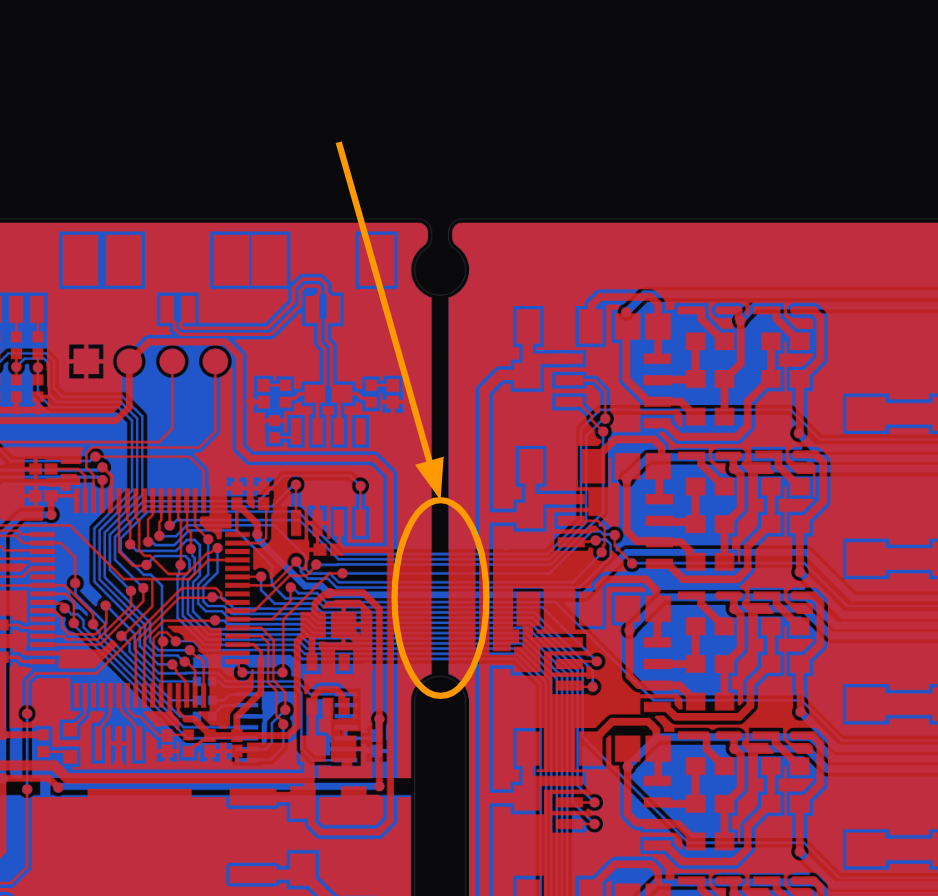
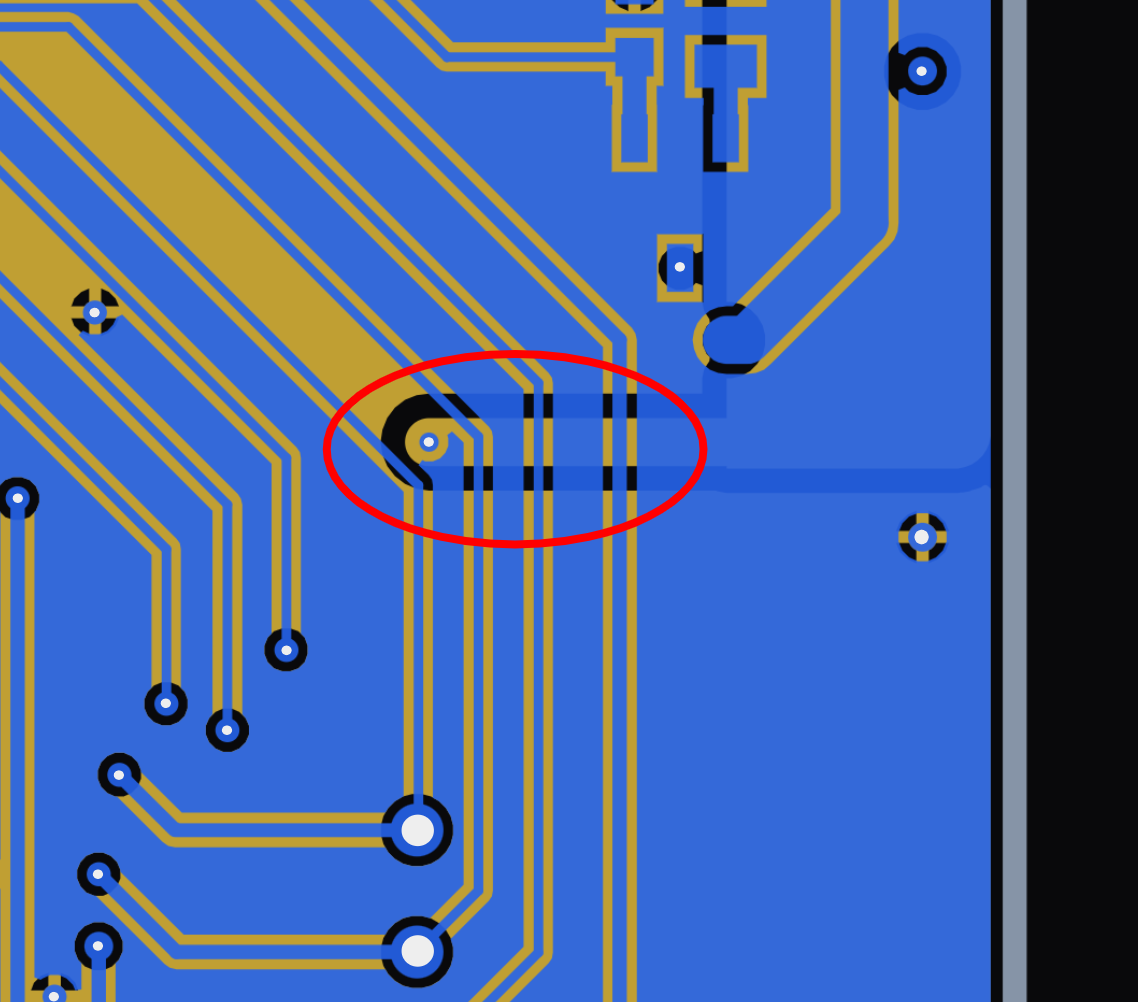
Routing high-speed microcontroller I/O traces over voids or splits in the reference plane is a fundamental design error that frequently leads to EMC compliance failures. In the layout image below from an open-source design, numerous traces cross discontinuities in the adjacent copper plane.
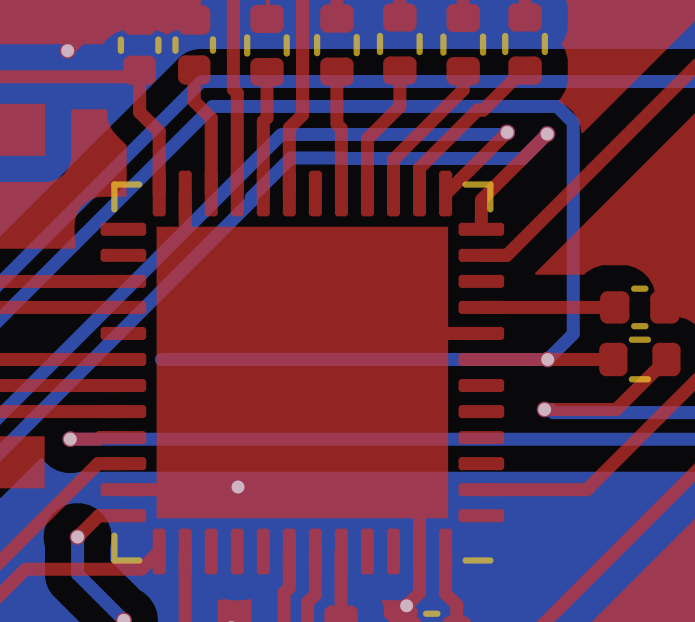
Here's the physics of why this fails:
• The Parasitic Loop: At high frequencies, return current follows the path of least inductance (directly beneath the signal trace). When a trace crosses a gap, the high-frequency displacement and conducted return currents are forced to physically detour around the void, creating a large parasitic loop area.
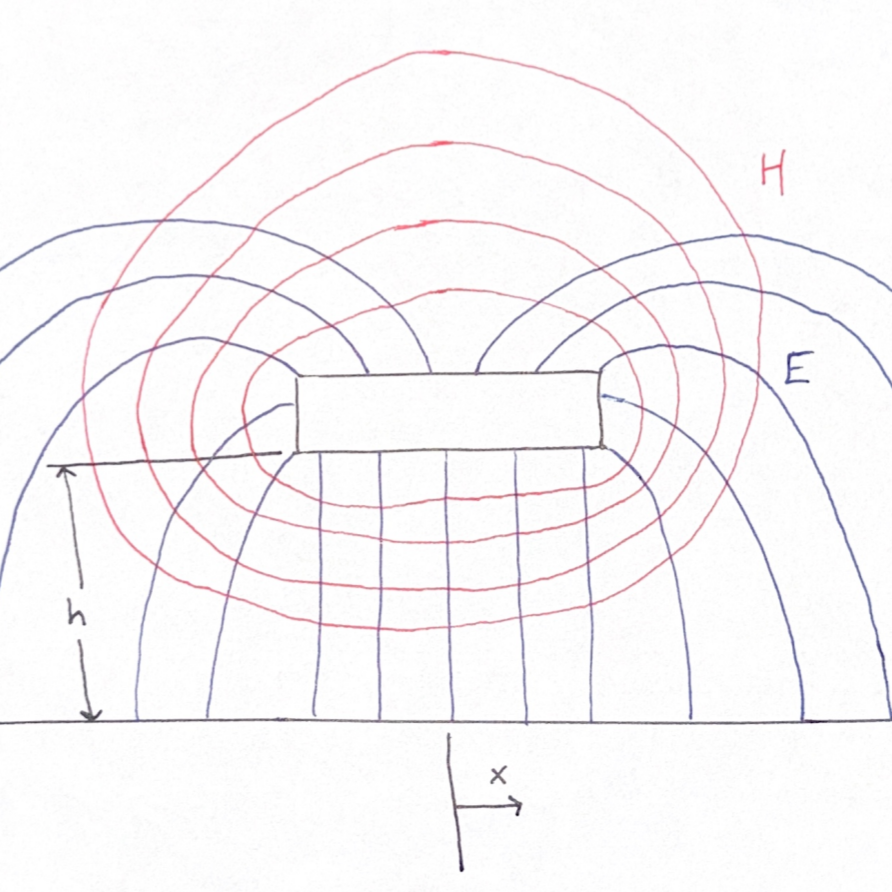
• Unbounded Fields: The discontinuity leaves the electromagnetic field unbound, causing it to leak and spread throughout the dielectric space.
• Common-Mode Conversion: When the fast edge rates of digital signals are driven across these gaps, the lack of an immediate return path causes a differential-to-common-mode conversion.
• The Antenna Effect: This unbounded field spreading generates common-mode currents that couple onto the return plane and flow out onto attached I/O cables. Because these external cables act as resonant dipole antennas, they become the dominant source of radiated emissions.
• Crosstalk: As the fields spread and the return currents crowd around the edges of the gap, they cross-couple into adjacent victim traces, severely increasing crosstalk.
Attempting to mitigate this type of emissions failure by applying external metal shielding at the test lab is generally ineffective, as the RF energy is radiating from the external cables rather than the enclosure.
Maintaining a continuous, unbroken reference plane adjacent to every signal layer is required to properly bound the electromagnetic fields and prevent common-mode radiation.